
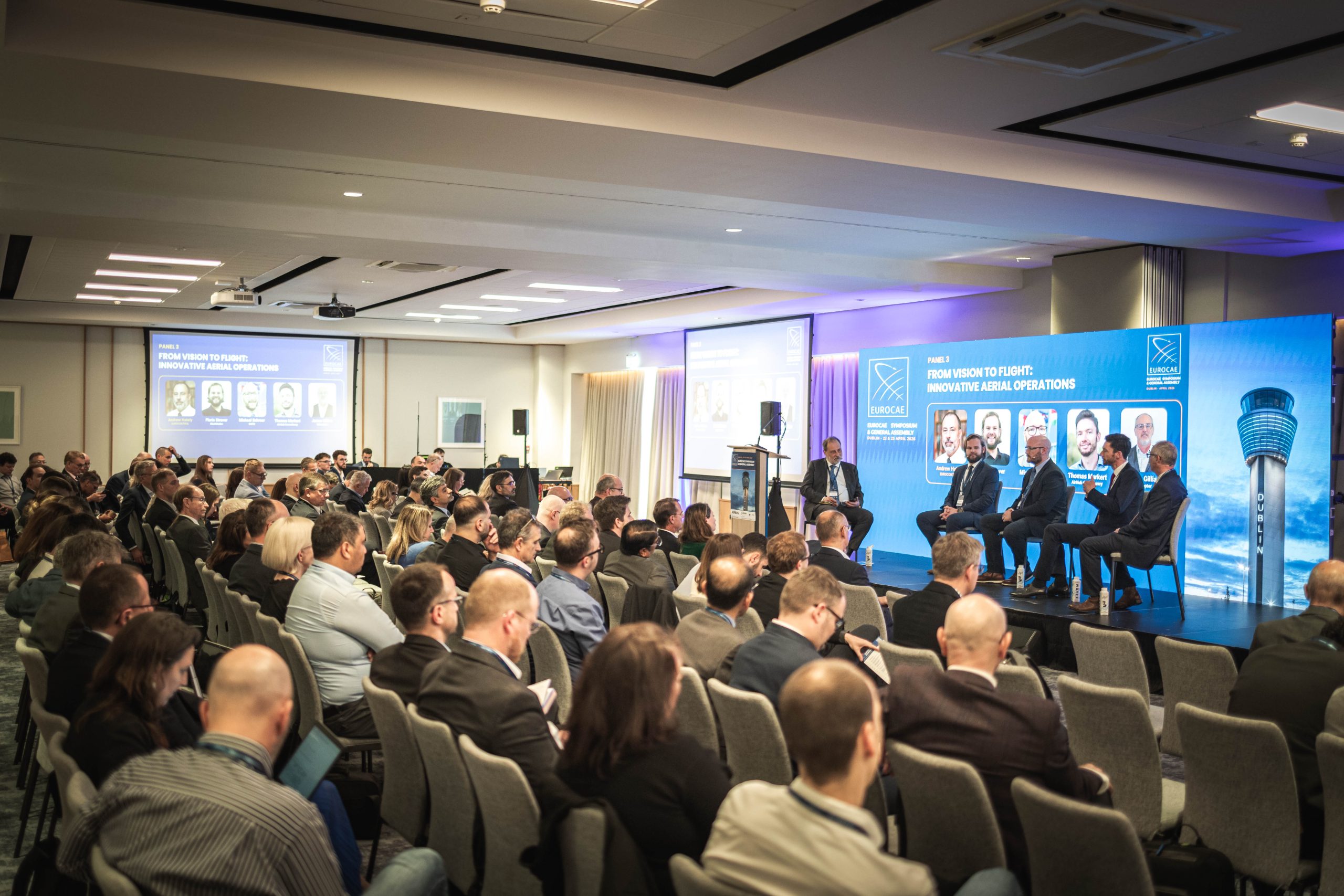
EUROCAE successfully concluded its 2026 Symposium, held on 22-23 April in Dublin. Marking only the second time Ireland has hosted the prestigious event since EUROCAE’s foundation in 1963, the Symposium brought together more than 150 industry leaders, regulators, and technical experts to address the rapidly evolving landscape of international aviation standards.
The event was officially opened by a distinguished panel including Guillaume Roger (President of EUROCAE), Frank Tone (Irish Aviation Authority), Gerald Caffrey (AirNav Ireland), and Eva Faure (Airbus). Their interventions reinforced a shared mission: robust, harmonised standards remain the foundation of aviation safety and the driving force behind both Irish and global aerospace innovation.
“Our goal was to bridge the gap between vision and implementation”, said Anna von Groote, Director General of EUROCAE. “By gathering insights from a diverse range of stakeholders, from European institutions to industry disruptors, we ensure that EUROCAE standards continue to be the global benchmark for safety, performance, and efficiency”.
Strategic Deep-Dives: Session Highlights
The Symposium featured six high‑impact panels, each addressing major challenges and opportunities shaping the future of aviation:
- Panel 1 – Part-IS Implementation after 6 months – State of play:
Speakers: Francois Péan (AirNav Ireland), Alain Combes (Airbus), Nikita Johnson (Rolls Royce), & Andy Boff (EGIS). Moderated by Angeliki Karakoliou (EASA).
EASA opened with an overview of the Part‑IS implementing rule. Panellists presented diverse organisational approaches, from ANSPs to major industrial manufacturers, highlighting challenges such as defining roles and responsibilities and mapping existing ISMS to Part‑IS requirements. The EUROCAE document ER‑040 on Information Security Management System (ISMS) was recognised as a key resource supporting implementation. Despite varied strategies, all speakers emphasised that strong ISMS implementation strengthens safety and benefits all actors.
- Panel 2 – Navigating the Threat: Ensuring Resiliency Against GNSS Disruption:
Speakers: Niklas Ahrens (European Cockpit Association), Okuary Osechas (ZHAW), Sai Kalyanaraman (Collins Aerospace), Ric de Sousa (NATS), & Antonio González (INDRA). Moderated by Christophe Vivier (European Defence Agency).
Experts entered a focused discussion on strengthening resilience against GNSS disruption. Panelists examined where today’s standards fall short, highlighting detection, system integration, reporting, system behaviour, and debated which areas should be prioritised for standardisation. The EUROCONTROL/EASA ‘European Aviation Action Plan for ensuring safe operations during GNSS interference’ was confirmed as the European response to the GNSS RFI issue.
- Panel 3 – From Vision to Flight: Innovative Aerial Operations:
Speakers: Michael Schroer (NATO), Floris Straver (Mainblades), Thomas Markert (AirHub Consultancy), & James Gillian (Volocopter). Moderated by Andrew Hately (EUROCONTROL).
Speakers concluded that advancing automation, developing harmonised regulatory frameworks, and deploying robust digital infrastructure will be critical to supporting the safe and scalable growth of UAS and eVTOL operations. As aviation enters this new era, standardisation plays a major role fostering collaboration between industry and authorities and capturing existing best practices to enable faster and more consistent implementation.
- Panel 4 – Towards Zero Emission Aviation: The Future of Propulsion Technologies:
Speakers: Helen Leadbetter (UK CAA), David Le Maux (Safran), & Antoine Toulemont (Aura Aero). Moderated by Jan Petter Steinland (Norway CAA).
The panel explored how emerging propulsion technologies, ranging from EHPS to hydrogen-based solutions, are redefining aviation’s trajectory toward sustainability. Speakers outlined the current state of development across industry initiatives, while also highlighting the major hurdles ahead, including infrastructure readiness and the complexity of certification pathways. The discussion underscored the value of regulatory sandboxes in enabling safe experimentation.
- Panel 5 – Accelerating the Implementation of a New Service Delivery Model for ATM in Europe:
Speakers: Simona Pierattelli (Leonardo), Michael Holzbauer (Frequentis), Jorge Mínguez (INDRA), Pascal Rohault (Thales), Morris Milekovic (DFS), Klaus Meier (Skyguide), & Athanassios Tziolas (EASA). Moderated by Alain Siebert (SESAR 3 Joint Undertaking).
The new Service Delivery Model for ATM presents both major opportunities and significant implementation challenges for European ATM stakeholders. The panel discussed the need for a clear framework for change, timely standards, and the need for an enabling regulatory framework. While some differences in perspective emerged, the discussion highlighted a broad convergence on one key point: this transition will require a coordinated European approach, with CP2 having an important role to play in aligning stakeholders and giving practical momentum to accelerate this transformation.
- Panel 6 – The first AI Standard is on its Way:
Speakers: Sandrine Serres (Airbus), Juliette Mattioli (Thales), Giacomo Gentile (Collins Aerospace), Guillaume Soudain (EASA), & Antonio Fernández (Anzen). Moderated by Marina Efthymiou (Dublin City University).
Panelists agreed that ED-324 accommodates the adaptive and data-driven nature of AI, while maintaining the high levels of safety expected in aviation. They highlighted that achieving trustworthy AI requires continued standardisation efforts that carefully balance innovation and certification needs. The ongoing work at EUROCAE represents a critical step toward the industry.
Alongside the panels, the Symposium showcased a dynamic series of Flash Talks:
- Tânia Cardoso Simões (EUROCONTROL) – Driving ATM Transformation in Aviation
- Mark Renzi (Collins Aerospace) – Air Ground Connectivity
- Mariagrazia La Piscopia (SESAR Deployment Manager) – European Innovation and Stakeholders Implementation
- Bobby Healy (Manna Aero) – Towards European Urban Drone Delivery
- Takafumi Nakada (ENRI) – Air Navigation System Transformation and Standard: A Glimpse into an Asian Initiative
- Miloslav Kafka (Honeywell) – The Evolution of Aviation Software Standards
- Lendina Smaja (European Commission) – Views from the European Commission
- Santi Ibarz (Airtel ATN) – How innovation and Standards Shape our Business Success
“EUROCAE will carefully analyse the conclusions from the Symposium and work closely with our Council and Technical Advisory Committee to refine our strategy and identify new standardisation needs arising from these discussions”, concluded Anna von Groote, EUROCAE’s Director General.
Symposium Highlights: New Council Members & EUROCAE Awards
The EUROCAE General Assembly met on 22 April, endorsing the activity report and strategic priorities for the coming year, and electing new Council members.
The Symposium also honoured outstanding contributions to aviation standardisation with the EUROCAE Awards 2026:
- Best Contribution Award: Cyril Marchand (Thales)
- Working Group Leadership Award: Nikita Johnson (Rolls Royce)
- Global Harmonisation Award: David Redman (ASVI)
- International Contribution Award: Hannes Alparslan (Emirates)
- Women in EUROCAE Award: Christelle Kutyla (Airbus)
- Lifetime Achievement Award: Wolfgang Engel (Airbus)
- President’s Award: Eric Bouchard (Dassault)
Looking Ahead to Prague 2027
EUROCAE announced that its next Symposium will be held in Prague, Czech Republic, on 21-22 April 2027. In line with EUROCAE’s strategy to diversify host countries and highlight regions that have hosted less frequently since 1963, this will mark only the second time the Czech Republic welcomes the event.
EUROCAE extends its sincere gratitude to all attendees, speakers, sponsors, and partners whose engagement and support were instrumental in making the 2026 Symposium a resounding success.
